When it isn't you talking
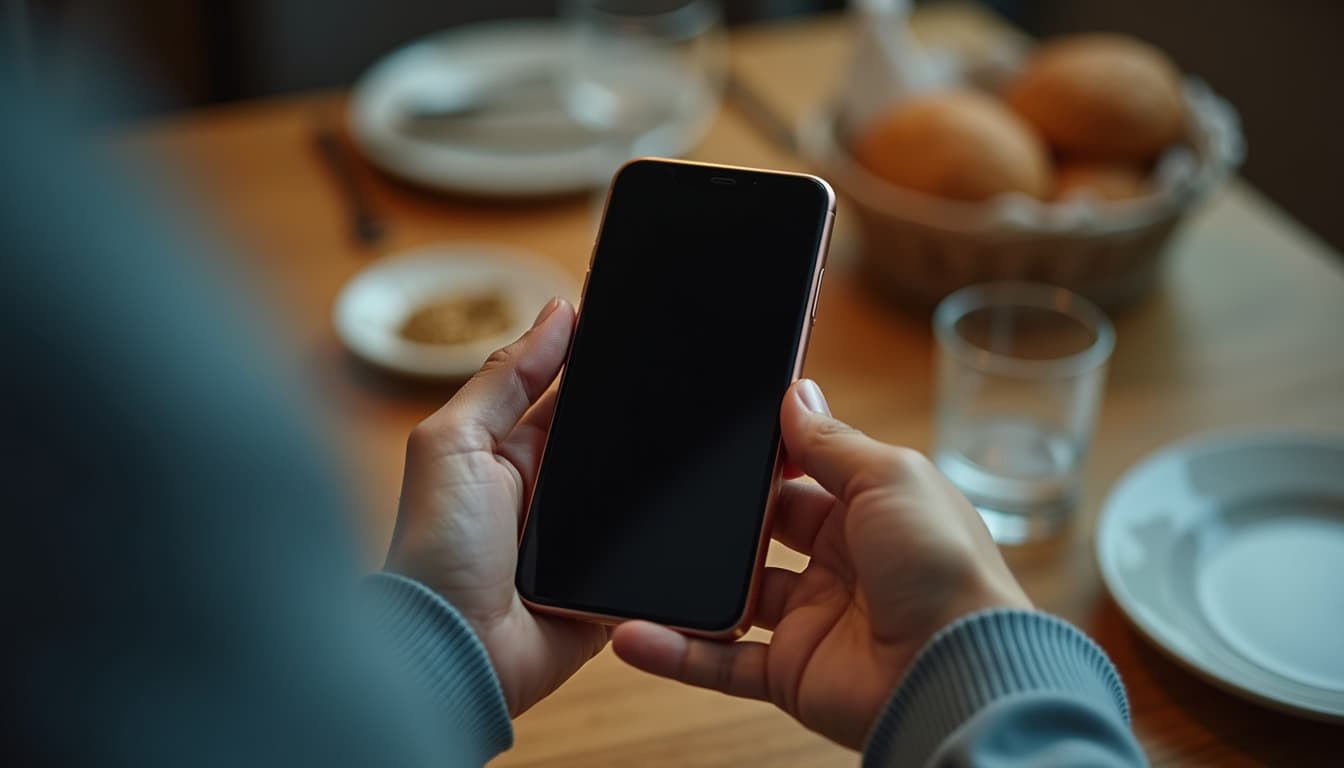
Until 19 May, everything said into the phone was put down to its owner. Hannah would borrow Tom's phone to ask a question, mention in passing that her family was from Portugal, and Tom's memory would note that his was. Since then, the app can be told who is talking. What someone else says is filed in the owner's memory, as a note the owner takes about that person, in the third person and attached to their name. The owner never changes. And after thirty minutes of silence, the app assumes the phone has been handed back.
A phone gets passed around
A phone is less personal than we like to think. It gets passed. At dinner, someone wants to know what time the chemist closes, and whoever has the phone in reach is the one who asks. A child wants to dictate what she would like for her birthday, and you hand her the phone because it is more fun than making her write it down. A friend, at the end of the meal, wants to give you the address of a restaurant he liked, and he says it straight into the phone, because that is quicker than typing it into a message.
For a note-taking app, none of these moments is a problem. For an app that remembers what you tell it and then uses that to answer you, it is a different matter. Every sentence it hears is read as a sentence from the owner. "I" means him. "My wife" means his. "I'm leaving on Friday" means he is the one leaving.
Until 19 May, that is exactly what happened. Hannah would pick up Tom's phone to ask something, and if she added in passing "my family's Portuguese, by the way, I speak Portuguese", the memory wrote down, in Tom's file, that Tom's family was Portuguese. And it was a silent mistake: the memory keeps what it judges important without saying so, so nobody saw a false fact being filed. It surfaced weeks later, in an answer that made no sense, and you had to trace it back to where it came from.
There was a more awkward case still. When the person talking says something that cannot be true of the owner, "I'm off to my midwife appointment" into a man's phone, the memory did not pause. It noted it. That was not a failure of logic on its part: it simply had no way of knowing the phone had changed hands.
A memory has one owner
First, what did not move, because everything else follows from it.
An account belongs to one person. Everything the app remembers is filed in that person's memory and nowhere else. There is no sub-account for the wife, child or friend who borrows the device, no "guest mode", no second memory that opens up beside the first. We thought about those options and dropped them fairly quickly. A profile for everyone who touches the phone means a list of profiles to manage, a choice to make before you can speak, and a privacy question that does not sit well: if Hannah wanted a memory of her own, it would be hers, on her phone, with her account.
The right model is simpler, and it is the one everybody already uses without thinking. When a friend introduces you to someone and that person tells you about their trip, you do not open a file in their name. You remember, for yourself, what you learned about them. "Sam's cousin is moving to Leeds." It is your memory, it is about him, and it lives in your head.
That is what the app has done since 19 May. The owner stays fixed. What changes is the point of view the memory is written from.
Saying who is talking
To change the point of view, the app first has to know that someone else is talking. It does not recognise voices, and we did not want it to: that would be fragile, and it is the kind of thing you would rather not find in a phone. It listens to what is said, like a person who cannot see the room.
Four kinds of signal are enough in practice. A direct introduction: "it's Hannah, not Tom", "this is Sam", "I'm his sister". A mention of the loan: "Tom's lent me his phone", "I'm borrowing his phone for two minutes". A contradiction: "no, you've got it wrong, it's Hannah talking". And a plain inconsistency, like that midwife appointment on the phone of a man the memory knows well. When doubt remains, the app asks one short question: "hang on, is that you, Tom, or someone else?"
When the signal is clear, it notes for itself that the speaker has changed, with their first name and, if it has understood it, their relationship to the owner: wife, daughter, brother, friend. That note is not a memory. It is not written anywhere in the memory, it appears on no card, it does not outlive the conversation. It is a state of the conversation in progress, in the same way as "what were we talking about two sentences ago". The fact that Hannah used the phone that evening is only kept if someone says so.
The choice to write nothing down comes from a simple idea: lending a phone is a moment, not a state. Nothing to set up, nothing to switch on, nothing to switch off afterwards.
Written from the owner's point of view
Here is the scene that served as the model.
Tom, at the table: "hang on, I'm passing the phone to my wife for a second." Hannah: "hi, it's Hannah. I wanted to ask you something about my weekend in Lisbon. Six of us are going, we leave Friday evening and get back Monday morning. Oh, and by the way, my family's Portuguese, I speak Portuguese."
The app has understood that Hannah is talking, and that she is Tom's wife. It keeps two things, and writes them like this: "Hannah is going to Lisbon on Friday evening with five friends, back Monday morning", and "Hannah's family is Portuguese and she speaks Portuguese fluently". Both memories are attached to Hannah's name, filed under family, and never under the area the app reserves for the owner himself. Neither begins with "I". Neither says "the user". They are notes Tom has taken about his wife, worded the way he would word them himself if he were writing them in a notebook.
And it answers Hannah on the substance of her question, with no "noted": the memory is always on, and it is not talked about.
Hannah: "thanks, I'll hand you back to Tom." The app notes for itself that the owner has the phone again. Tom, a little later: "by the way, where exactly is Hannah going?" And the app answers, because the answer is in his memory, under Hannah's name, where he is looking for it.
The third person is not a matter of style. It is what makes these memories usable later. A fact written "my family is Portuguese" in Tom's memory is false. The same fact written "Hannah's family is Portuguese" is true, it is in its place, and the links between memories start from the right point: from Hannah, to her trip, to her friends, to the language she speaks.
The child who dictates, the friend who tells a story
The same rule applies whenever the phone changes hands, and those cases are more varied than a loan between partners.
Ellie, eight, dictates what she would like for her birthday. The list exists, it is attached to Ellie, and when Tom asks three weeks later "what was it Ellie wanted again?", he will find it. Sam, at the end of the meal, gives the name and address of the restaurant he was talking about. The place is kept, attached to Sam, filed under friends, not as one of Tom's addresses. If Hannah says "Tom and I are going on holiday together in August", that is a fact about Tom, but it is kept as coming from Hannah, attached to her, under family. The owner is never erased from his own memory; he is simply the one listening.
This rule does not do everything, and it is better to say so. It does not protect Tom's memory from the person he has handed the phone to. Hannah, phone in hand, can ask what Tom has noted on any subject, and the app will answer, as it would answer Tom. An unlocked phone in someone's hand is a phone you have entrusted to them. The app does not pretend to protect it from the person you gave it to; it makes sure not to mix up what that person says with who the owner is.
Thirty minutes of silence
Most of the time, the owner says when he is back. "It's me again", "I'm giving you back the phone", "thanks, I'll take it from here". The app listens for that. It also listens for sentences only the owner could say: a mention of his employer, of a treatment it knows he takes, of a project that is his.
But sometimes you take your phone back without saying a word. Hannah put it down on the table, Tom picked it up an hour later to note down something to buy. If the app still believed it was talking to Hannah, it would file that errand under the wrong name, and we would have swapped one mistake for its opposite.
Hence the thirty-minute rule. When a conversation stays silent for half an hour, the app forgets who was holding the phone and returns to its default: the owner is talking. A phone loan lasts as long as a question, a list, an address. A long pause is the natural sign that the device has been handed back. And if Hannah starts talking again after those thirty minutes, she only has to say so, or let it show, to be recognised again.
That declaration lived inside the current conversation, and that same afternoon we found that the conversation itself was being lost at the slightest break in the connection. The declared speaker evaporated with it. So the work of 19 May had two halves: in the morning, teaching the app who is talking; in the afternoon, making sure it does not forget when the screen goes dark.
The second look adapts too
There was one place where the old reflex could come back in through the window.
Since the day before, every answer from the app has been followed by a quiet second pass, which rereads the sentence it heard and counts the facts it contained. If the memory let one slip, this second look catches it and files it.
That second look had its own instructions, written for the owner: a fact is a lasting piece of information about the user, you write it short, in its place. Applied as they stood to Hannah's sentence, they would have produced exactly the mistake we had just fixed: "the user's family is Portuguese", filed under Tom's personal area, after the first reading had done things properly. Two readings, two opposite results, and the wrong one came last.
So it had to be told, too, who is talking. When someone else is holding the phone, its instructions change: every fact it catches carries that person's name, goes into an area that is not the owner's, and is written in the third person, as a note taken about that person. The owner is not the subject of those facts; he is the one keeping them. The two readings now say the same thing.
What this changes, and what it does not
You hand over the phone, you say who you are if you think of it, you hand it back. What was said in that moment is in the owner's memory, attached to the right person, written the way he would write it himself, and he finds it again simply by asking "what did Hannah tell me about her trip?". Over time, his memory fills with the people who pass through his phone, the way ours fills with the people we are introduced to.
And there are limits worth knowing. Recognition depends on a signal. Someone who picks up the phone without a word and dictates a list will be read as the owner, exactly as a person who answers your phone without introducing themselves is taken for you. There is no separate memory for the guest, no partition, no account on the side. A memory belongs to one person, it is written from their point of view, and everything that enters it, including through someone else's voice, enters as something they have learned.